Ere Perez says NO to Animal Testing in Australia

At Ere Perez we believe very strongly in the need for a total ban on animal testing for cosmetics.

Last year Cruelty Free celebrated a historic moment as Cruelty Free’s founding organisation, the campaign led by BUAV (British Union for the Abolition of Vivisection) to end animal testing for cosmetics finally came to an end in Europe – with the last phase of the European Union’s ban coming into force.

Now it’s time for Australia to get on board too and recently UK comedian and actor, Ricky Gervais spoke on behalf of the Be Cruelty-Free Australia campaign.

Coordinated by Humane Research Australia and Humane Society International, it is part of the largest campaign in the world to end animal testing for cosmetics such as lipstick and shampoo.

The End Cruel Cosmetics Bill was introduced in March 2014 by Greens Senator Lee Rhiannon, and seeks to ban both cosmetics animal testing within Australia, as well as the import and sale of newly animal-tested cosmetics from abroad. This would mirror the historic ban in place across the 28 member countries of the European Union, the world’s largest cosmetics market.

Animal testing for cosmetics is still legal in Australia. Although often assumed to occur infrequently, there are no official statistics to show how often such tests are conducted here or how many animals are subjected to cosmetics suffering. Additionally, many of the cosmetics on sale in Australia’s shops will have been tested on animals in another country.

We are a Cruelty Free brand and believe there is absolutely no excuse for animal testing to occur anywhere in the world for the sake of cosmeticsWe only test on friends and family! And we never use any unsafe ingredients. Why would we? Ere Perez

So if you want to get behind the bill to ban animal testing in cosmetics in Australia, click here to send an email to your Senator asking them to support the End Cruel Cosmetics Bill.

For more information and a who’s who of Cruelty Free ambassadors, go to www.choosecrueltyfree.org.au.

MELLOW MACRAME: BRING BACK SEVENTIES NATURAL CRAFT STYLE

Your crochet hooks may have been hijacked by your kids for their insatiable loom band cravings, but you can still get that old school crafting look with some of Eco Chic’s Macrame pieces. Macrame bedheads, lampshades, plant holders, pendants and wall hangings are all the rage this year. Now that hippy crafty chic is back and we say all hail macramé, because it’s natural, handcrafted homestyle chic at its laid back, effortless best.

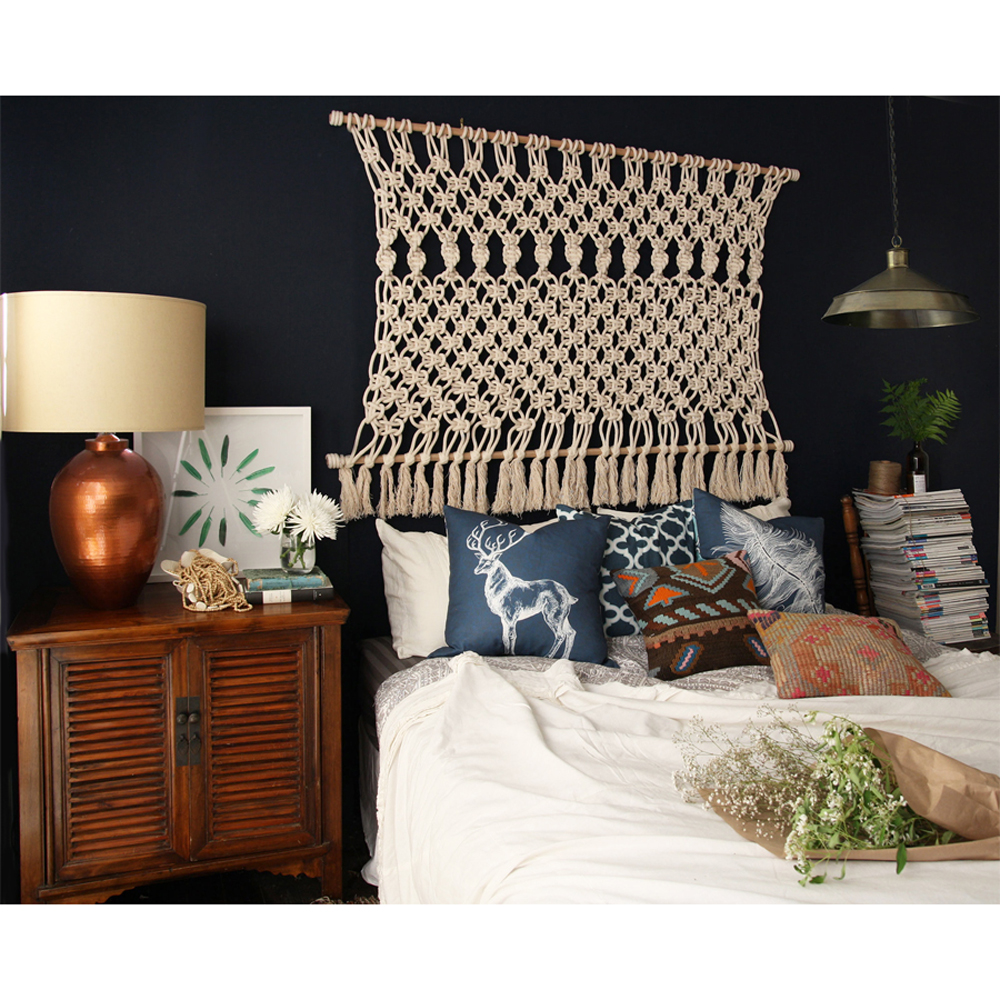
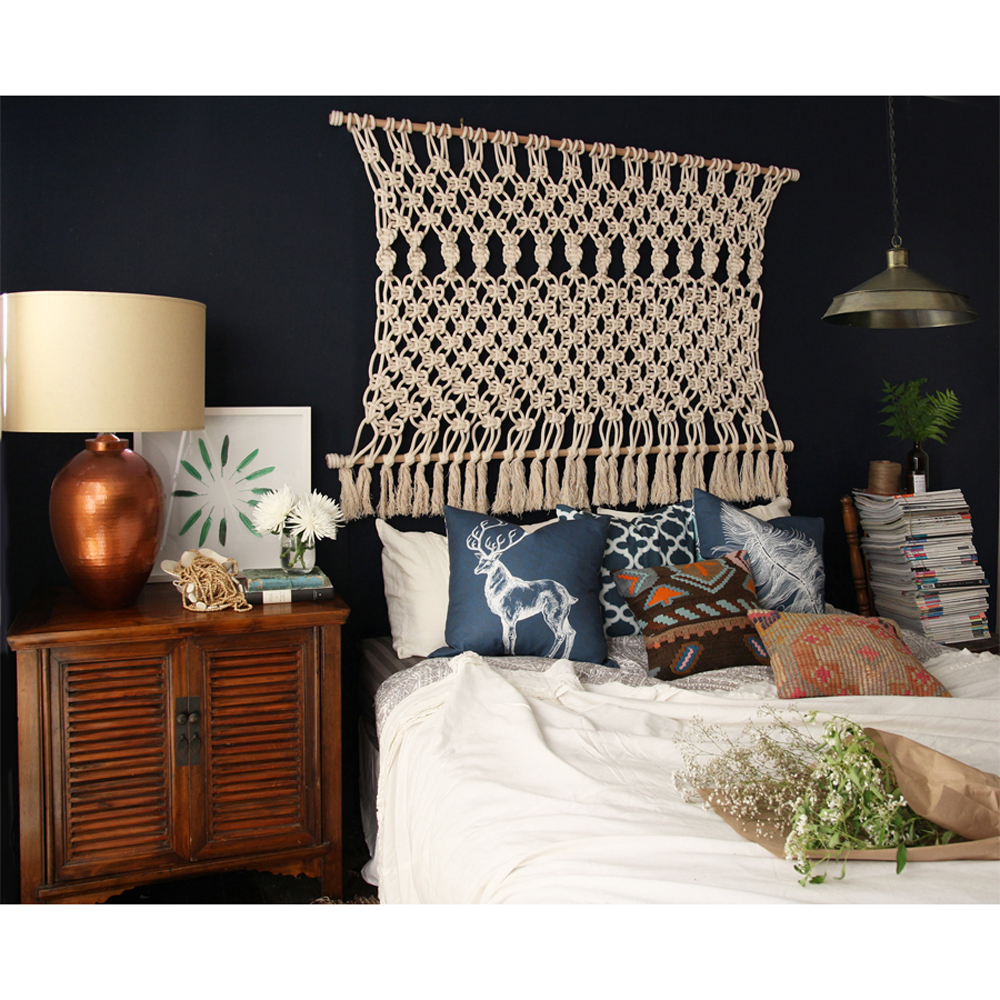
Originally a 13th Century Arabic weavers’ EcoChic_1012953_MacrameWallHangingBedheadword meaning “Fringe” it refers to the decorative fringes that kept the flies out of the eyes of camels and horses. And if you were a child in the seventies you will remember your mum in deep concentration making some macramé plant pot hangers. Every house had one. Beeded, trimmed, fancy or plain, you couldn’t go into a house without knocking into a spider plant in a macramé plant pot holder!

At Eco Chic we just love it when old style gets revamped to create such beauty in a new piece. The following handcrafted macramé pieces have been created by Kay Lonergan, a talented local weaver, and we are so proud to showcase her talents.

MACRAME BEDHEAD
Step away from the usual wooden or fabric bedheads, and try a textural talking point for your home. Handmade (of course) from white cotton yarn, this beautiful and unusual bedhead will stylishly dress up a plain bedhead or can be hung behind a bed to create a bedhead look.
Queen Size: 158cm wide x 110cm high x 4cm deep. $980.

MACRAME PENDANT LIGHTEcoChic_1012952_MacramePendantLight
This amazing pendant light is really something different! As Eco as you can get, it is hand made from off-white cotton cord to form this unusual and eye-catching pendant. Obviously this pendant would look marvellous in a study or library setting, but also ultra cool in a restaurant or commercial application.
Pendant Light Size: 40cm diam x 60cm high. $560

MACRAME WALL HANGING
Wall hangings are very much on trend this year as interesting and beautiful wall art. Made from off-white cotton cord, our Macrame wall hanging is so simple it’s just gorgeous and will look perfect in a beachside airy living room, breezy bedroom or even on a verandah. Overall Size: 71cm wide x 91cm high x 2.5cm deep. $475.

For more information and to view everything in store at Eco Chic, go to http://www.ecochic.com.au.

MEDIA ONLY:
For more information, pricing, photography or product, for shoot, or for interviews with Cris Bucknall or Paula Breckman, please contact sophie@prchicks.com.au.

Dealing with autism in child care

What to do if you suspect your pre-schooler is Autistic

Autism, although not exactly common, is increasingly more known in our society. That’s not to say it’s been proven to be more prevalent than in previous years, but we’re getting better at diagnosing it.

Pretty much everyone will have a friend or relative with a child who suffers from autism, or Autism Spectrum Disorder, so called because of the huge range of difficulties and behaviours it encompasses.

These include difficulties with:

  • Social interaction (e.g. Seeming unaware of others and/or disregarding social conventions)
  • Social communication (e.g. Delayed or absent verbal language, and/or reversing pronouns)
  • Imagination (e.g. Having limited and unusual interests, and insisting on sameness).

The most commonly encountered children will be those with Asperger’s Disorder, which is widely regarded as “a lesser form of Autism”, but nonetheless on the scale and difficult to deal with as a parent or carer. In the case of Asperger’s there is no language delay, although communication difficulties still exist.

Despite rumours surrounding the MMR vaccine, which were subsequently laid to rest and dismissed as unsubstantiated scare-mongering, Autism is genetic. But there is still a lot about Autism that isn’t known. It varies hugely in symptoms and levels. It’s not curable, although some parents and autistic people have found ways of dealing with it and have successfully managed to live with and operate in society at a reasonably “normal” level. We use that term normal loosely of course. At the end of the day, with any child, what is normal?!

Autism is more prevalent in, though not exclusive to males.

It’s often hugely misunderstood. And the behaviour of the kids who are dealing with Autism is also often misread or mis-diagnosed.

Generally speaking, Autism is most likely to be picked up or diagnosed sometime after 18 months, which these days means that a child may well be in child care before, during and after diagnosis.

Frequently asked questions are:

  • Do autistic kids need to go into special care?
  • Are they able to attend a regular day care?
  • Do they need specially trained carers in child care?
  • What are the pros and cons of inclusive care?
  • What are the signs to look out for?
  • What do I do if I suspect my child might be autistic?

Children with autism can be included in regular child care situations, although carers should be trained in dealing with children with ASD. Not only can the normality of the situation help the kids with Autism, but also dealing with anyone with a disability of any type on a daily basis encourages tolerance, compassion and understanding. Qualities that cannot be underestimated in today’s society.

There are many ways children with ASD can be helped in a non-specialist child care facility:

For many autistic children, visualisation is key, particularly if they have language delay. Photos on lockers, pictures, faces and emotions, coloured indicators of areas and spaces are all very helpful to both autistic and non-autistic kids.

Defined areas are also great at helping physical structure and understanding of activities. Things like mats for specific areas, divisions, reading corners, mood boards and weatherboards – anything that helps define activities is very effective.

Changing norms and adapting behaviours are also key. Autistic children often find direct contact or lack of personal space upsetting. You don’t have to sit facing children, they can be told to sit side by side, which is much easier for an autistic child. Story time just has to be slightly rearranged. Expectations of certain behaviours changed.

Journalist Josie Gagliano, has a son, Rafael, who was diagnosed at 20 months. Here she recounts how she and her son’s child care service dealt with his particular needs.

C4K: Was Rafael already diagnosed with ASD before or after starting child care?

JG: No, he wasn’t yet, but I knew by then. He was 1 year and 8 months old when he started childcare, and I already had concerns. In fact, that’s why I put in child care one day a week, to help develop him further, and because they assured me they’d had children with special needs at the centre. My son was diagnosed with mild autism at age 2.

C4K: What were the early signs for you? Did you notice them or were they pointed out by someone else?

JG: My son would not respond to his name, and he previously had. That and the fact he stopped saying any words at all were my big signs. Plus, at playgroup, he would not join the other kids to play. Instead, he was happy to do his own thing.

C4K: How did your child care then address his and your needs?

JG: They had additional funding to cover an extra teacher at the centre, so she could concentrate on helping him. The other teachers were also on board and knew how to interact with him and how to get the best out of him.

C4K: Were there any issues while he was in child care and how did you overcome them?

JG: I always needed to ensure we were on the same page, working towards the same goals. This meant having meetings and checking in from time to time. Most of the time, things went smoothly, as we had extra funding to have an additional teacher at daycare to attend to his needs.

At his special needs-specific playgroup it was a different set up altogether: very much focused on his needs and strengths and weaknesses, and working towards improving social and play skills, as well as developing his speech via sessions, and occupational therapy sessions as well.

C4K: What advice would you give to parents who think their child may be autistic or who have just found out their child has ASD?

JG: The BEST advice is: get a diagnosis ASAP. And if your hunch is mistaken and your child is not autistic, then at least you will know – it could be an alternate concern, not autism, and you could address that instead. If there is an autism diagnosis given to your child, early intervention is key. Another very important piece of advice (said with love) is: Allow yourself a ‘mourning’ period, allowing yourself the time to be sad about the loss of your dream of a raising a neurotypical child. He or she will instead thrill you and bring you joy is so many other ways, and this new way of approaching your child, and recognising strengths and little triumphs will pull you through those first few months, and the years to come.

Find out more about Josie and her son’s journey and also more about dealing with Autism on her blog

First thing is to always consult with your GP as soon as you suspect anything is wrong. Second is to talk to your child care service and discuss issues with them. Don’t be worried that you won’t find child care; most centres are willing and able to help you.

For more information on Autism, check out the following websites:

www.autismspectrum.org.au

www.autismpartnership.com.au

Stuck for childcare and no family nearby?

A Granny Au Pair may be just what you need!

As we all know, quality child care is in short supply and if you’re in the position where you’d love a nanny, but don’t have the funds, or you could do with some grandparent help, but have none nearby, then the latest child care inspiration – The Granny Au Pair – could be just the thing.

You may have previously discounted the idea of an au pair due to the image of a young, homesick studenty sort with possibly little experience in child care. Or you might have been put off by another image: the super-efficient, six-foot, gorgeous blond from Scandinavia. But perhaps it’s time to reconsider…

Would the idea of a more mature age woman, from your mother’s generation appeal? A woman who has reached retirement with a desire to travel and see more of the world, but not necessarily with the funds to be able to do so on her own and looking for a nice family to live with and help out for a summer or a set period of time?

Well it’s entirely possible. With an ageing population and a more sprightly generation of pensioners who want to see more of the world when they finally retire, more mature ladies (and some gentlemen), aka “granny au pairs”, from all over the world have increasingly been using their experience of raising children and running a household to travel around the world and expand their horizons while staying with families who need a helping hand with the kids and chores.

There are a number of agencies specialising in granny au pairs, but one of the first was the eponymous Granny Au Pair, based in Germany and the brainchild of German woman, Michaela Hansen, who created an au pair agency purely for the over 50s.

Hansen missed the opportunity to be an au pair and travel when she became a mum at 20 and launched the initiative to send young-at-heart grandmas from Germany all over the world after watching a TV programme about young au pairs.

“I thought: Why isn’t there something similar for older women?” A few months later she set up Granny Au Pair – an online portal that places women aged over 50 abroad as ‘au pair grannies’.

Granny au pairs however can bring with them a wealth of experience in child care, housekeeping, cooking and managing a household and can bring with them an added dimension to a family, particularly when grandparents aren’t living nearby.

Hansen believes they can be much more beneficial to families than younger au pairs: “Young people often still lack prudence and sensitivity. Older au pairs draw on a wealth of life experience and take the daily challenges in their stride. They are active and curious and eager to find out about other cultures and customs and they want to improve their language skills”.

Like most au pairs, they take care of children in exchange for room and board. There is usually no pay, though the family and au pair are free to come to an arrangement, and a membership fee is paid to Granny Au Pair.

From India to Australia, Dublin to New York, granny au pairs have been putting smiles on children’s faces over the past three years with Granny Au Pair.

Click here to search for au pair agencies in your area.

With regards to “hosting” a granny au pair in terms of visa compliance, it is a very grey area (geddit!). Most grannies would be on a visitor visa and may not therefore be working for or supplying services to an organisation or other person based in Australia’, according to Immigration website. However on a Tourist or Visitor visa, you can volunteer…

“Tourist and Visitor visa holders may be able to work as a volunteer where the work is genuinely voluntary and no remuneration is received in return for the activities”, but if the family pays pocket money, expects at least 25 hours per week or even if they offer to pay for the au pair’s flight as part of their arrangement, this could be deemed as remuneration.

As with all foreign travellers and people hoping to work in Australia, would-be granny au pairs or host families should check compliance with visa status with the Department of Immigration or an au pair agency. For additional help go to www.volunteering.com.au or www.volunteering.com.au.

When researching this story the general comment from the team here at CareforKids.com.au (as most of us are mums) is that we personally couldn’t imagine anything worse than going to do chores for someone else’s family and kids when we are in our dotage, but who knows… the travel bug may get us and we’ll be off to live-in some swanky mansion in LA to look after Brad & Angelina’s grandchildren! Life could be worse.

Published for CareforKids.com.au http://www.careforkids.com.au/newsletter/2014/april/23/